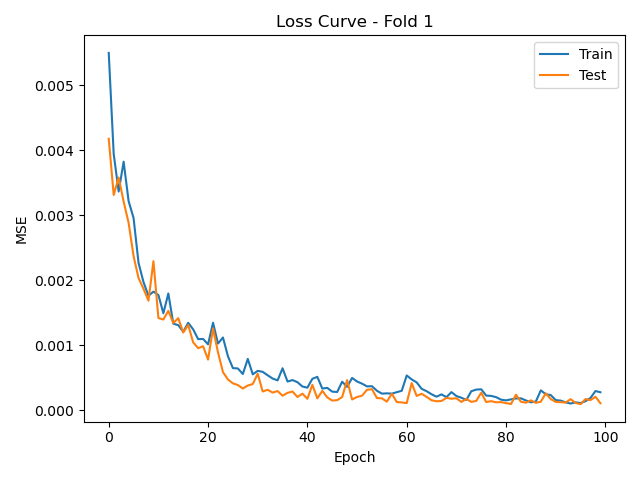
Loss Curve
This research focuses on developing Neural Operator–based surrogate models to simulate and generalize tau-protein progression in the human brain — a key process for understanding neurodegenerative diseases. These models learn the underlying spatiotemporal dynamics governed by partial differential equations (PDEs), serving as efficient data-driven surrogates for complex biophysical simulators. The framework employs Fourier Neural Operators (FNO) for global spectral learning, Wavelet Neural Operators (WNO) for localized multi-scale resolution, Graph Kernel Networks (GKN/MGKN) for topology-aware learning on the brain connectome, and DeepONets for functional mappings between biological parameters and temporal trajectories.
The dataset represents simulated tau-protein propagation dynamics across 30 brain nodes and 150 time steps. Each sample encodes variations in four biological parameters (γ₁, λ₁, δ, ε) influencing the PDE-based diffusion–reaction equations governing tau accumulation. The input vector combines these parameters with the initial tau distribution (τ₀) across nodes, while the output is the full temporal trajectory of tau evolution. Parameter ranges are log-scaled and normalized to ensure numerical stability and to enable generalization across unseen regimes.
Optional node selection (0–9)
